

Dog behaviour problemsWhen the problem isn't obedience.
Fear, anxiety, reactivity, destructiveness. They aren't stubbornness or bad manners: they are responses to something. We work on the cause, at your home, in the context where the behaviour happens.
Do any of these sound familiar?
If your case isn't on this list, tell me anyway. These are the most common, not the only ones.
Separation anxiety
Barks, howls or destroys things whenever left alone, even for a short time.
Reactivity to other dogs
Barks, pulls or stares when seeing another dog on the street, and can't look away.
Specific fears
Thunder, fireworks, the car, men, stairs. Refuses, trembles or tries to run away.
Destruction at home
Furniture, doors, shoes. Almost always when nobody is around.
Excessive barking
At the doorbell, at passers-by, at the neighbour. Doesn't stop when you ask.
Resource guarding
Growls or stiffens near food, toys or the sofa.
The behaviour isn't the problem. It's the symptom.
A dog that destroys the door when you leave isn't angry with you. It's panicking. If we only work on the door, the panic finds another way out. That's why the first thing I do isn't to correct, it's to understand.
How we work
Initial assessment
I come to your home to meet the dog, the family and the routine. I observe the behaviour in the context where it happens, which is rarely the same as what I'm told on the phone.
Finding the cause
Fear, frustration, excess energy, accidental learning. The same behaviour can have different origins, and the plan changes with the origin.
Behaviour modification plan
Concrete exercises, step by step. We start at a distance or intensity at which your dog can still think, and gradually get closer.
Independence
You learn to read the signs and apply the strategies yourself. The sessions become less frequent until they're no longer needed.
Eleven months of trying, five sessions
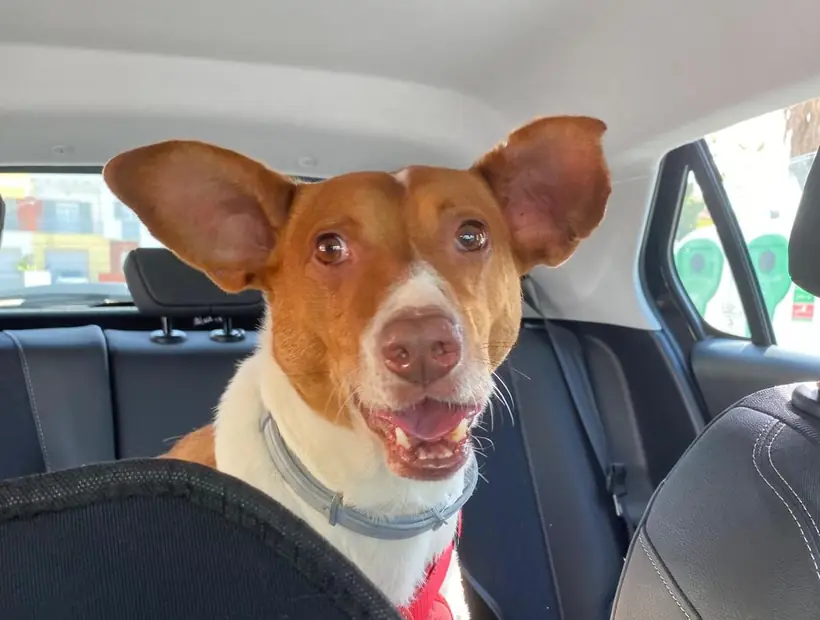
Trainer Inês Almeida, from Smartdogs, successfully solved, in just 5 sessions, a problem that had dragged on for 11 months. I found Joca, a mixed-breed dog, on the street and adopted him. Joca couldn't get into the car and, for 11 months, I tried several approaches, always without success. (…) In the 5th (last) session, I managed to get Joca into the car without using food and take a trip of about 55 minutes with him.Translated from Portuguese
What we won't do
- Shock, prong or choke collarsThey suppress the behaviour without addressing the cause, and in cases of fear they tend to make it worse.
- Dominance and "alpha dog" theoryIt is based on observations of captive wolves, which the very researcher who popularised them spent decades refuting.
- Confronting the dog with what it fearsExposing a frightened dog to what frightens it, hoping it will get used to it, is the quickest way to make a fear worse.
Frequently asked questions
How long does it take to solve?
It depends on the problem and on how long it has been going on. A recent fear is resolved faster than a habit of years. In the initial assessment I can give you a realistic idea, and I'd rather tell you it will take time than promise you a miracle.
My dog growled. Is he aggressive?
Growling is communication, not aggression. It's the dog warning you before escalating, and it's a good thing that he does it. What you shouldn't do is punish him for growling, because what that teaches him is to skip the warning.
He has several problems at once.
That's normal. They are usually linked, and working on one often eases the others. We decide the order in the assessment.
Do you need to be a certified trainer to work with dogs in Portugal?
In Portugal, there are specific requirements for training dangerous or potentially dangerous dogs. In these cases, the mandatory socialisation and obedience training must be carried out by a trainer holding the relevant professional title issued by DGAV, under Decree-Law no. 315/2009 of 29 October, as amended.
For other dogs, there is no general DGAV certification required to work in dog education or training. The DGAV professional title is specifically linked to the training of dangerous and potentially dangerous dogs provided for in the law.
There are, of course, other courses and qualifications in dog education and behaviour, but these should not be confused with the specific professional title issued by DGAV for training these dogs.
To consult the legislation and official information on this topic, you can check with DGAV.
Do you work with dogs of breeds classified as potentially dangerous?
Yes, as long as the dog does not show aggressive behaviour and the case does not require the mandatory training provided for in the law.
I can work with dogs of breeds legally classified as potentially dangerous that have everyday education and behaviour difficulties, provided the training is appropriate and safe.
However, I do not provide the mandatory socialisation and obedience training required for dangerous or potentially dangerous dogs, as this must be carried out by a trainer holding the relevant professional title issued by DGAV.
It is also important to distinguish a dog of a potentially dangerous breed from a dog that shows aggressive behaviour. The law provides for different situations in which an animal is classified as potentially dangerous or dangerous, and aggression can be relevant in its own right in that framework.
Each case is assessed individually, always prioritising the safety of the dog, the family and the other people and animals involved.
Tell me what's going on.
In two or three lines. I'll tell you whether it's a case for me and what I would do next.