

Positive reinforcement obedience trainingUseful skills for everyday life.
Reliable recall, self-control and useful behaviours, taught with positive reinforcement at your home and on your street. The goal isn't a dog that obeys for the sake of it, but a dog that understands what you're asking.
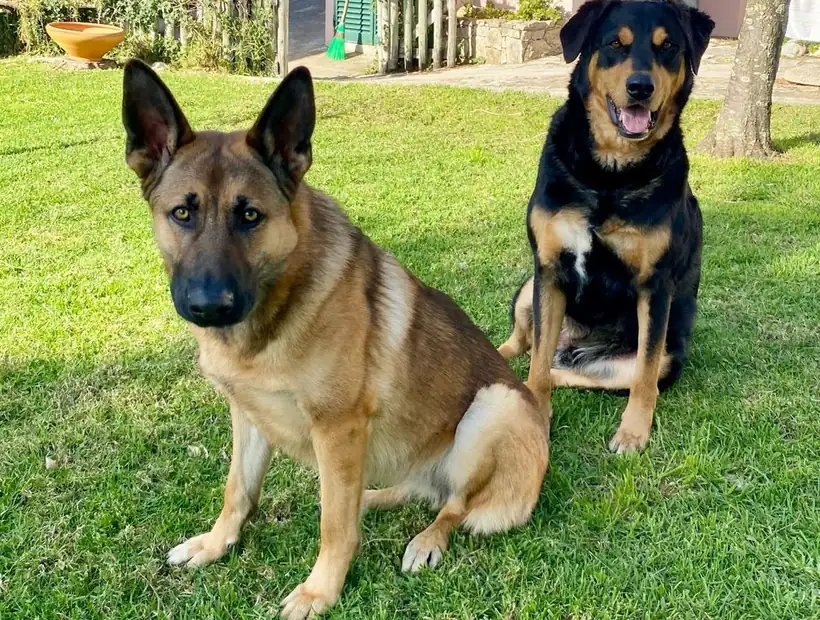
Skills for everyday life
Coming when called
A recall you can rely on, even with distractions around.
Sit, down and stay
The basics, taught so that they also work outside the house.
Self-control
Waiting at the door, at mealtimes and before going out, instead of jumping at everything.
Good routines at home
Clear, consistent rules the whole family can keep.
Focus with distractions
Training on the street, where distractions are real, not just in the living room.
How we work
We talk
You tell me what's going on, what you've already tried and what you'd like to change.
Initial assessment
A first session at your home to get to know the dog, the family and the routines, and to set goals.
Private sessions
One-to-one sessions at your home, with exercises adapted to your daily life.
Independence
You learn to apply the strategies yourself and the sessions become less frequent.
From chaos to calm
Ninja started training with Inês as a Jack Russell full of energy, anxious and responding to practically no commands — he really was a handful! With Inês's patience, dedication and methods, we saw an incredible change: Ninja is much more disciplined, calm and responds to commands easily.Translated from Portuguese
Frequently asked questions
My dog only obeys when I have food. Is that normal?
It's common at the beginning. In positive reinforcement a reward is a learning tool, not a permanent bribe: as the behaviour becomes established, we vary and reduce the rewards.
He obeys at home, but not outside.
That's completely normal. Learning at home, without distractions, is the first step. Then we train outside, with bigger and bigger distractions. It's one of the advantages of training at home: we practise exactly where you need it.
Want a dog who listens?
Tell me what they already know and what's missing. I'll tell you where to start.